Orbiba Newsroom
S2 Xpeed Interview: From Family Farms to Autonomous Fields
S2 Xpeed published a founder interview with Orbiba Robotics on why weed control is still one of farming's hardest jobs, how a single autonomous platform can carry many tools, and how field data becomes a decision a grower can act on.
- Published
- 30 July 2026
- Original source
- S2 Xpeed

An interview about where the vision started
S2 Xpeed, the European industrial technology platform, published a founder interview with Orbiba Robotics. It covers why weed management is still one of the hardest problems in farming, how autonomous robotics changes day-to-day field operations, and what a modular, AI-driven platform actually means for a working farm.
The starting point is not a laboratory. Orbiba Robotics grew out of a farming family and the everyday economics that family lived with.
"I come from a farmer family, and I grew up seeing firsthand the challenges farmers face every day: labour shortages, rising production costs, difficult field conditions, unpredictable farming environments, and the heavy dependence on chemical herbicides."
That background set the brief. Farmers are asked to farm more sustainably while margins tighten, labour gets scarcer and environmental rules get stricter. The answer had to be practical and affordable before it was clever.
Why weeding is the hard problem
Weeds compete with the crop for nutrients, water, sunlight and space. Without chemical herbicides, organic and regenerative growers fall back on hand labour or mechanical cultivation, and both are expensive, slow and increasingly hard to staff.
"Farmers need solutions that can distinguish crops from weeds in real time and operate safely under varying field conditions."
That is the real requirement: not more horsepower, but precision that holds up as light, soil and growth stage change through the season.
From a single machine to a platform
Orbiba's answer is an autonomous robot that pairs AI computer vision with autonomous navigation and treats each plant individually instead of dosing the whole field uniformly. Interventions happen only where they are needed, which lowers both input use and running cost.
The second design decision is modularity. The same autonomous base carries different tool units depending on the task and the season: precision weeding, hoeing, planting, monitoring, and more to come. One platform does the work of several single-purpose machines, so the investment earns its keep across more of the year.
Turning field data into decisions
Alongside the robot, Orbiba's field analysis system uses sensors, cameras and AI models to track crop condition, weed pressure and variability across the field. The point is not the data but what it feeds: earlier interventions, better allocation of inputs, and season planning that rests on measurement rather than habit.
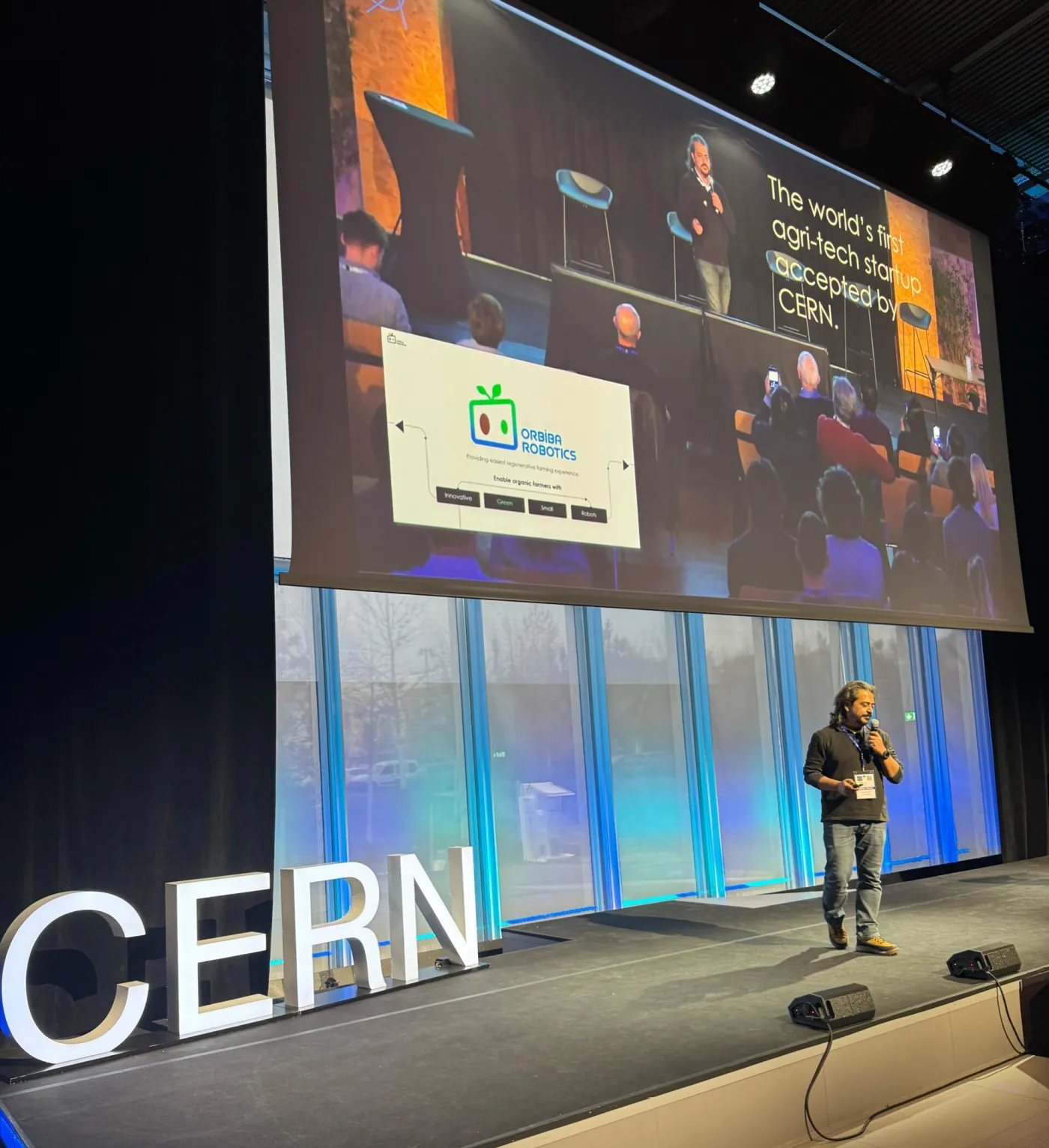
Orbiba Robotics founder and CEO Ilker Bektas on stage at CERN, where Orbiba became the first agri-tech startup accepted into the Venture Connect programme.
Where this is heading
Looking further out, the interview describes agriculture shifting from a labour-intensive, reactive system to an autonomous, data-driven one, with robots taking the repetitive work and farmers keeping the decisions.
"We see AI and robotics fundamentally reshaping agriculture from a labor-intensive, reactive system into a highly autonomous, data-driven, and precision-oriented ecosystem."
The roadmap runs through field validation across more crops and more geographies, a wider range of modules, and an integrated agricultural operating system that ties robotics, AI and field analytics together. The goal stays the same throughout: let growers produce more sustainably while protecting soil health and cutting chemical dependency.
Source: This original editorial summary is based on the S2 Xpeed interview "From Family Farms to Autonomous Fields: The Vision Behind Orbiba Robotics", published 30 July 2026. Cover photo: Leo Dubois, Agri-Food Public Affairs Summit 2026.
Original source
S2 Xpeed
Visit source